In drilling and exploratory operations, subsurface logs are frequently acquired in disjointed runs across varying probe tools (Gamma Ray, Density, Neutron, Caliper, Resistivity, Temperature). Stavid Suite scans directory archives, statistically detects identical duplicate channels via Monte-Carlo sampling, mathematically aligns depth indexes, generates standard CWLS LAS files, and renders publication-grade multi-track composites.
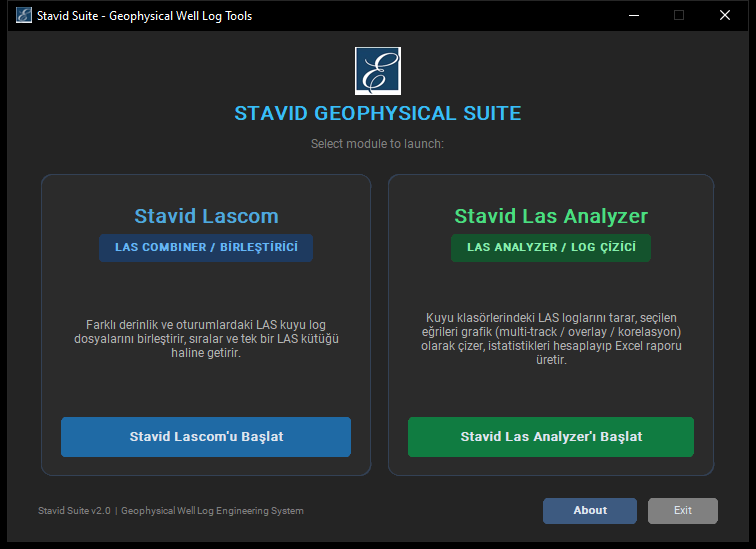
Upon launch, Stavid Suite presents a centralized, dark-mode control window enabling researchers to dynamically boot either the automated LAS Combiner (Stavid Lascom) or the analytical visualizer (Stavid Las Analyzer).
From unorganized multi-run field files to character-perfect CWLS standard archives and publication-grade well log plotting.
A high-throughput alignment engine that processes multi-run well log files, mathematically syncs depth intervals, cleans redundant channels, and produces uniform LAS files ready for modeling.
[|<<] [<] [>] [>>|]) across thousands of borehole sub-directories.
GR_1, GR_2 channels.
A comprehensive well log visualizer and quantitative analyzer designed to generate multi-track composites, overlay curves, apply signal filtering, and compile statistical parameter spreadsheets.
sharey) with 0m at top for intuitive downward stratigraphic scrolling.
Stavid Suite incorporates a dedicated Publication Mode that renders clean, high-contrast, paper-ready figures formatted for academic journals, technical reports, and peer-reviewed subsurface studies.
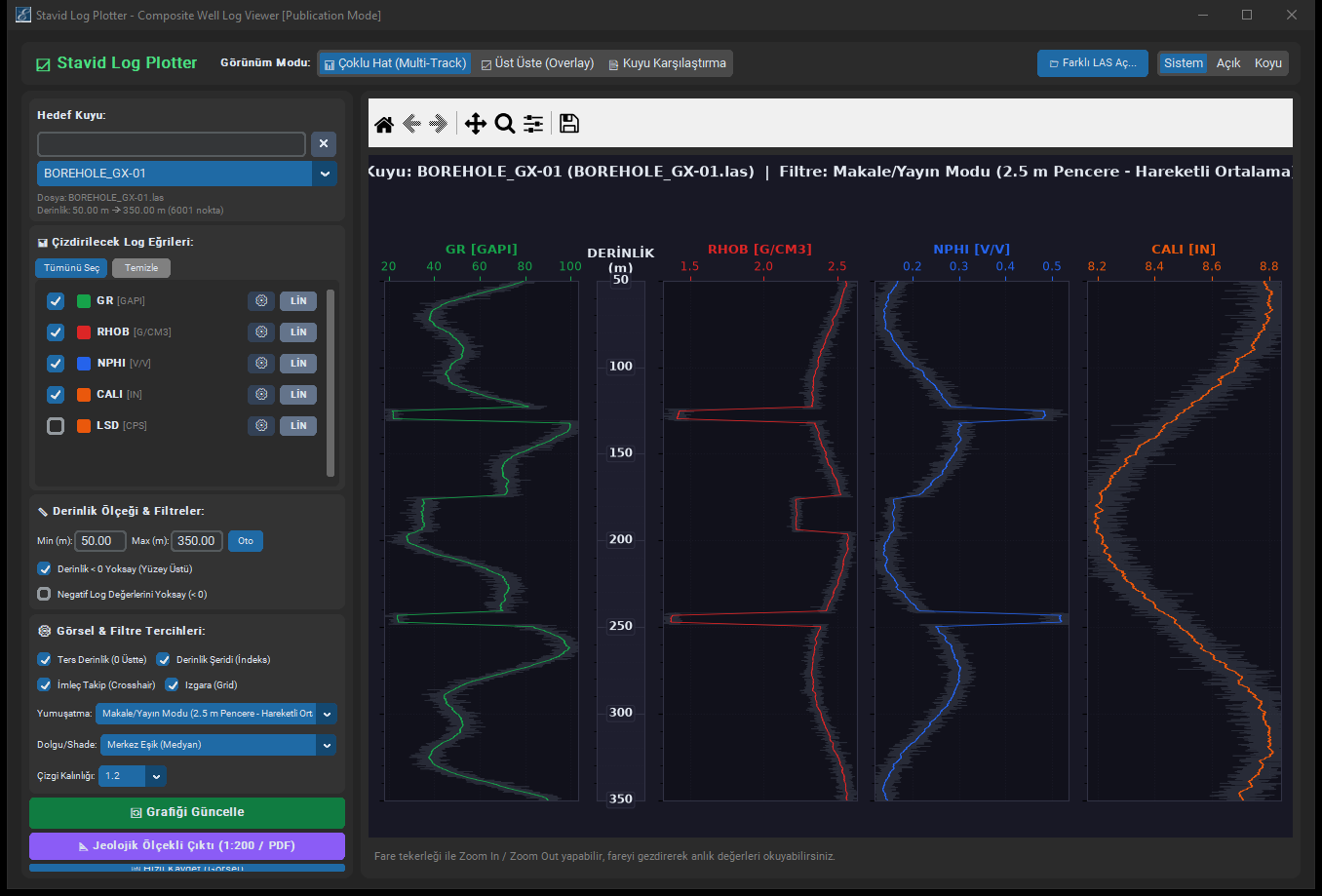
Real program capture of Stavid Log Plotter executing the 2.5m moving average smoothing window, dedicated central depth column, and lithological cutoff shading on synthetic borehole BOREHOLE GX-01.
Publication / Article Mode. Left sidebar provides real-time control over multi-track display, borehole selection, 2.5m moving average smoothing filter, dedicated central depth track toggle, coal/facies cutoff shading, and live crosshair cursor readouts. Central viewport displays multi-track composite with Gamma Ray (GR), dedicated metric depth column, Bulk Density (RHOB), Neutron Porosity (NPHI), and Caliper (CALI).
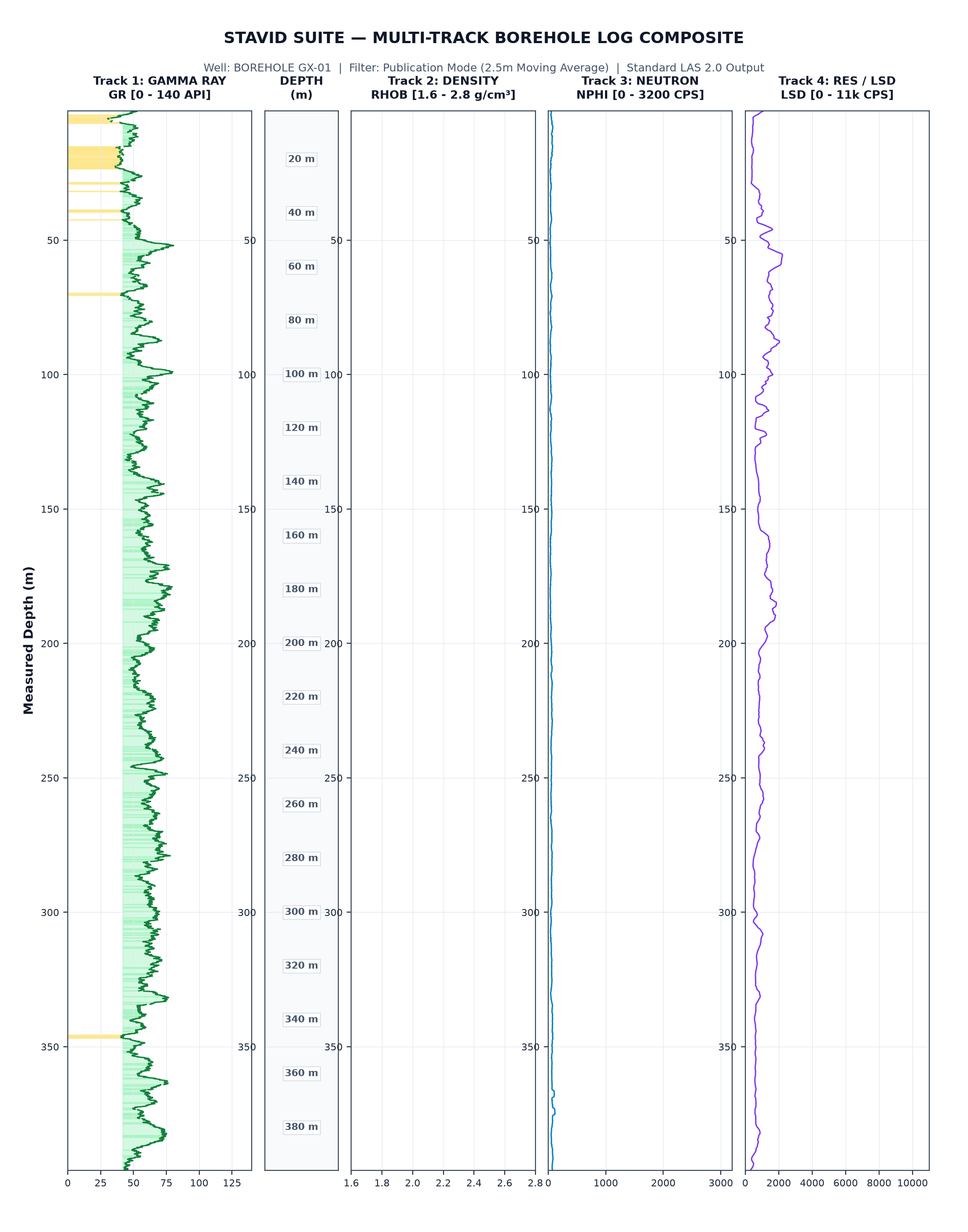
Vector-grade composite well log rendered with pure white publication background, formal journal typography, and lithology shading.
BOREHOLE GX-01 synthesized by Stavid Lascom from multi-run probe sessions. Track 1 illustrates Gamma Ray (GR, API) with yellow cutoff highlighting high-permeability sandstone and coal facies (≤ 42 API) and green baseline shading for shale/claystone intervals. Track 2 displays the dedicated central metric depth column. Tracks 3, 4, and 5 show bulk density (RHOB, g/cm³), thermal neutron porosity (NPHI, CPS), and deep resistivity / long-spaced density (LSD, CPS). Filtered via the built-in 2.5m window moving average algorithm.
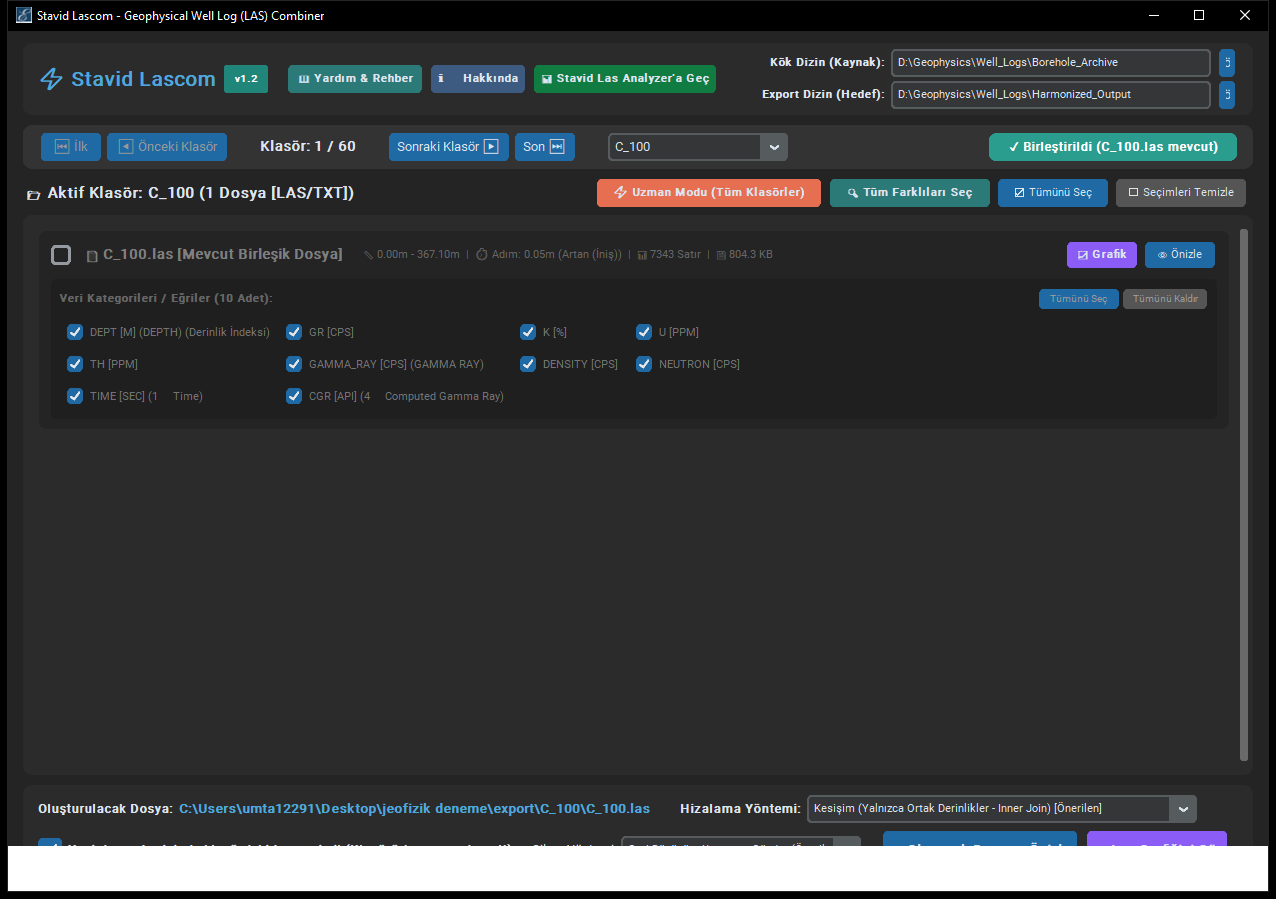
Real desktop capture of the Stavid Lascom harmonization interface displaying directory stepper navigation, multi-run file cards with curve checkboxes, depth alignment selection, and in-memory preview.
BOREHOLE GX-01 (1/1)), per-run curve selection cards, join algorithm configuration, and direct launcher hooks to the log plotter.
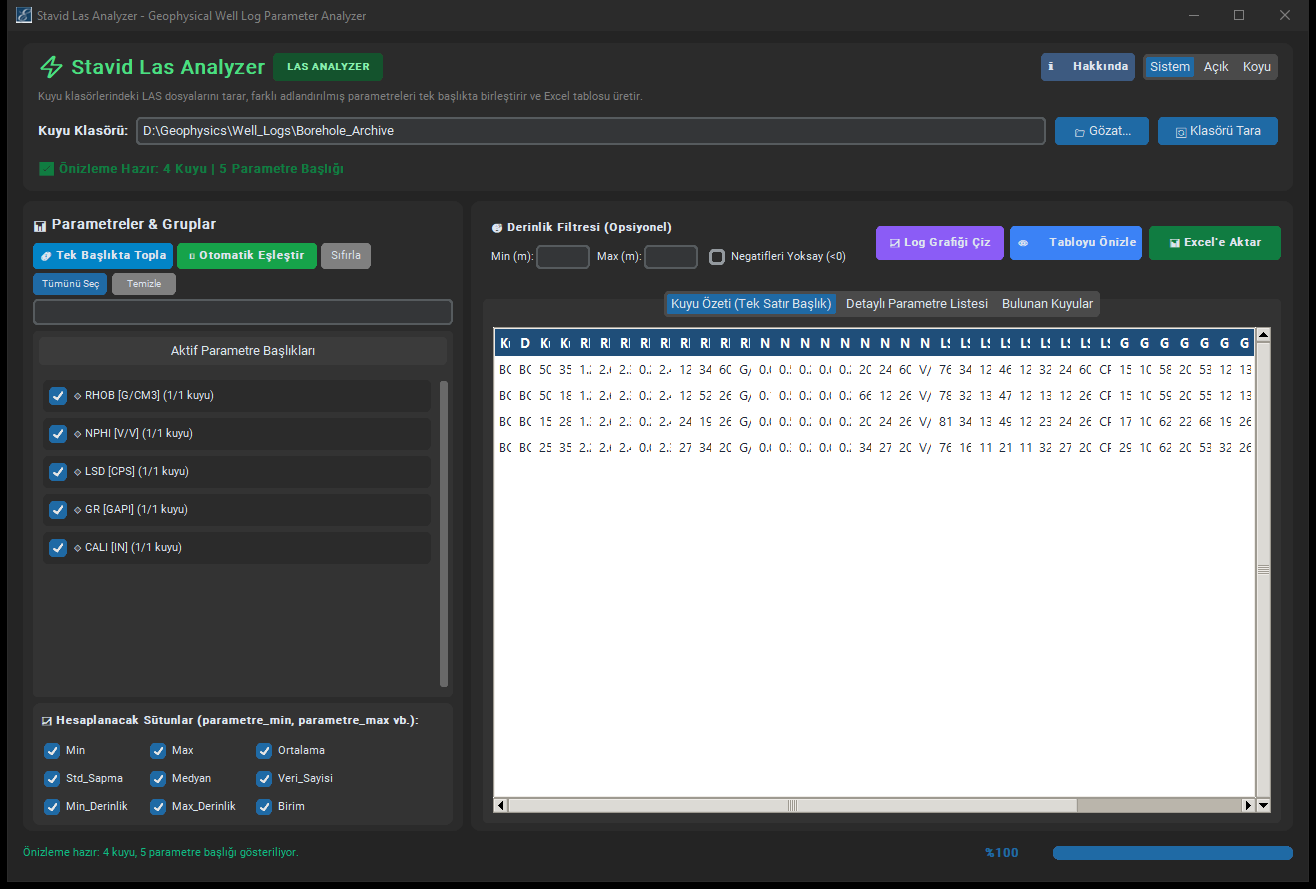
Real desktop capture of Stavid Las Analyzer executing borehole directory scanning, multi-parameter curve grouping, automated depth interval parsing, and quantitative single-header Excel summary calculation.
BOREHOLE GX-01. Features include automated parameter grouping (RHOB, NPHI, LSD, GR, CALI), statistical filters (Min, Max, Mean, Standard Deviation, Sample Count), and the single-row analytical summary matrix ready for modeling.
Standard spreadsheet merges fail when handling well logs due to uneven probe sampling frequencies, missing depth intervals, and strict CWLS formatting rules. Stavid Suite was engineered to eliminate these bottlenecks.
When multiple runs contain same-named curves (e.g. GR), Stavid samples 15 to 20 random non-null and non-zero depth rows. If numerical values match across all sample points, it verifies identical data and eliminates redundant channels automatically.
Legacy geological packages (WellCAD, Geosoft, Petrel) require strict column alignment in the ~A ASCII data block. Stavid computes max numerical character widths and pads each column header to align precisely with its data values.
The plotting engine incorporates cubic Savitzky-Golay filtering (polyorder=3) to eliminate high-frequency probe noise while preserving sharp geological boundary transitions and peak amplitudes without flat-topping.
Subsurface Computing & Open Research Initiative
Stavid Suite was engineered to address real field data fragmentation and borehole log reconciliation challenges. Interested in technical exchange, code design, or collaboration on subsurface software? Let's connect.